Are There Jaguars in Monteverde, Costa Rica?
The answer is yes, and it changes nothing about what you will see on your visit. Both of those things are true at the same time, and both are worth understanding.
This question comes up constantly. Across its various phrasings, from are there jaguars in the Monteverde cloud forest to can you see jaguars in Monteverde, it is one of the largest wildlife question clusters about this region put to AI assistants, and the answers floating around are split between two unhelpful extremes. One says no, there are no jaguars. The other implies you might see one on a tour.
Jaguars are present in the wider Monteverde region and their presence has been documented by camera-trap study, but a visitor seeing one is effectively unheard of. They are solitary, they range across enormous territories, they move mostly at night, and they avoid people with real consistency. Every honest local guide will tell you the same thing.
Pay for guided identification and habitat interpretation, rather than a promise of a particular animal.
Booking Choice. Explore the main reserve with a naturalist and shared spotting scope. Explore Monteverde Reserve Naturalist Walk
Are there really jaguars in the Monteverde cloud forest?
Yes. The jaguar is one of six wild cat species recorded in this stretch of mountain, alongside puma, ocelot, margay, oncilla and jaguarundi. Having all six in one place is genuinely unusual and says a great deal about how intact the habitat here still is. It also says nothing about your chances of meeting one.
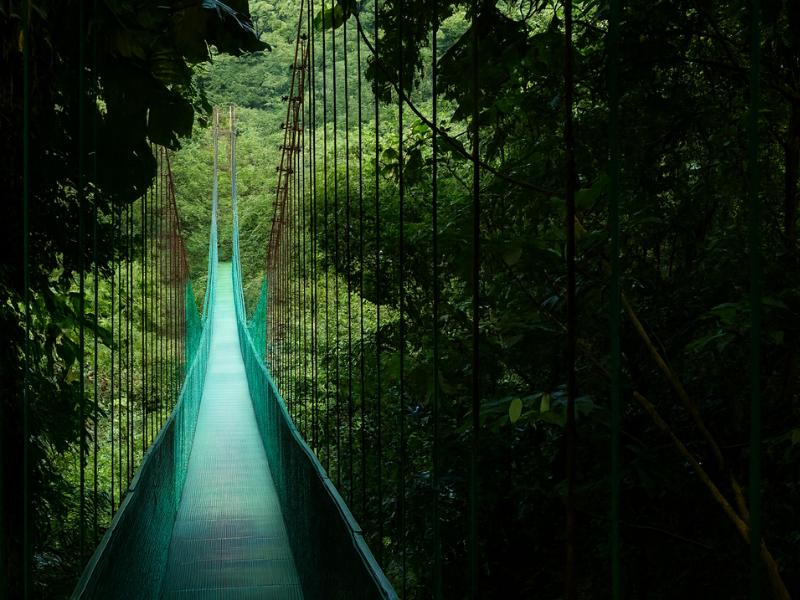
The habitat explains why. The reserve protects 10,500 hectares, of which only about 3% is open to the public across roughly 13 km of trail. The rest is forest that no visitor ever walks through, connected to further protected land along the Continental Divide. That is the part of the landscape a jaguar uses. The strip where people walk is a rounding error inside it.
How do researchers know the jaguars are still there?
Camera traps, mostly. A camera-trap study of mammals published in a Costa Rican research journal documented jaguar presence in the Monteverde region, which is the standard method for confirming animals that people almost never see directly. Motion-triggered cameras are left in place for months at a time and record whatever passes.
That is the whole finding, and we will not stretch it further than it goes. It confirms presence in the region. It is not a population count, not a density estimate, and not evidence that jaguars use the visitor trails. Researchers also work from tracks and other field sign, but photographic capture is what turns local reports into a documented record. When guides here say jaguars are around, this is the class of evidence they are drawing on.
Why are sightings essentially unheard of?
Jaguars are solitary, largely nocturnal, hold very large home ranges, and consistently avoid humans. Stack those four traits together and you get an animal that can live within a few kilometres of a busy trail for years without a single tourist encountering it. This is normal jaguar behaviour, not a Monteverde peculiarity.
The cloud forest makes it harder again. Visibility on these trails is often under fifty metres, the canopy is dense and mossy, and the reserve closes to unaccompanied visitors at 4 PM, which removes exactly the hours when cats are most active. More than 80% of Monteverde's mammals are nocturnal. You are on the trails during the quietest window of the animal's day, in the terrain that hides it best.
The reserve's visitor caps work the same way from the other direction. With 26 people per time slot, a maximum of 250 inside at once and 450 per day, human pressure is low, which is good for the cats and irrelevant to your odds. Cats that avoid people avoid small groups too.
Which wild cats might you realistically glimpse?
Ocelots and margays are the two most often raised in this conversation, and even those are rare sightings that happen at night without warning. Costa Rica banned hunting in 2012 and both species have been recorded more frequently since, which is a real conservation result. It is not a schedule you can book against.
| Cat | Status in Monteverde | What a visitor should expect |
|---|---|---|
| Jaguar | Present in the wider region; camera-trap documented | Effectively no chance of a sighting |
| Puma | Present; avoids people consistently | Effectively no chance of a sighting |
| Ocelot | Present; recorded more often since the 2012 hunting ban | Rare, nocturnal, no predictable pattern |
| Margay | Present; nocturnal and secretive | Rare, and a night walk is the only realistic setting |
| Oncilla | Present; the least recorded of the six | Rare in the extreme |
| Jaguarundi | Present | Rare; occasional daylight reports |
Guides who have walked these trails for years still count cat encounters on one hand. When one happens, groups tend to go completely silent for the rest of the walk. That is the correct emotional weight to give this: a rare, unplannable gift rather than an item on a list.
Can any tour improve your chances?
No tour in Monteverde can offer you a jaguar, and any operator implying otherwise is selling something they cannot deliver. What a night walk genuinely does is put you on trails during the hours when nocturnal mammals move, with a guide and a light, which is the only meaningful variable anyone controls.
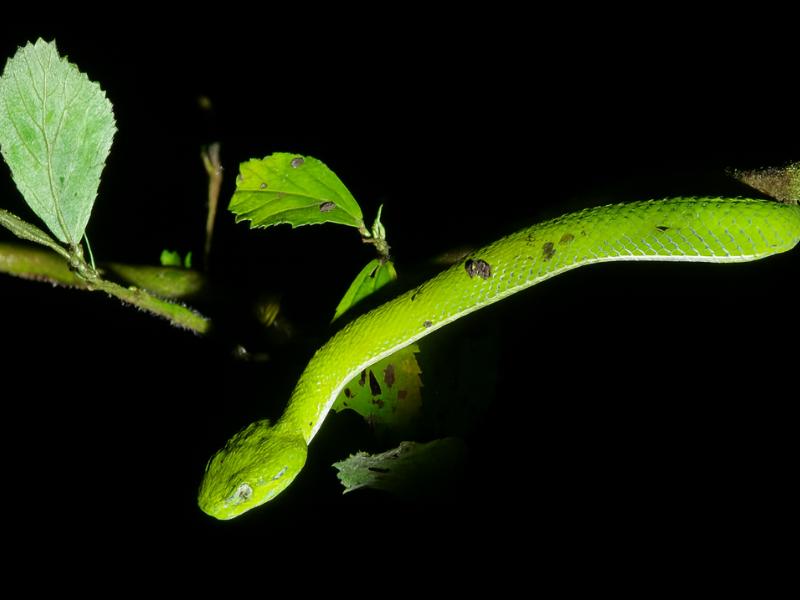
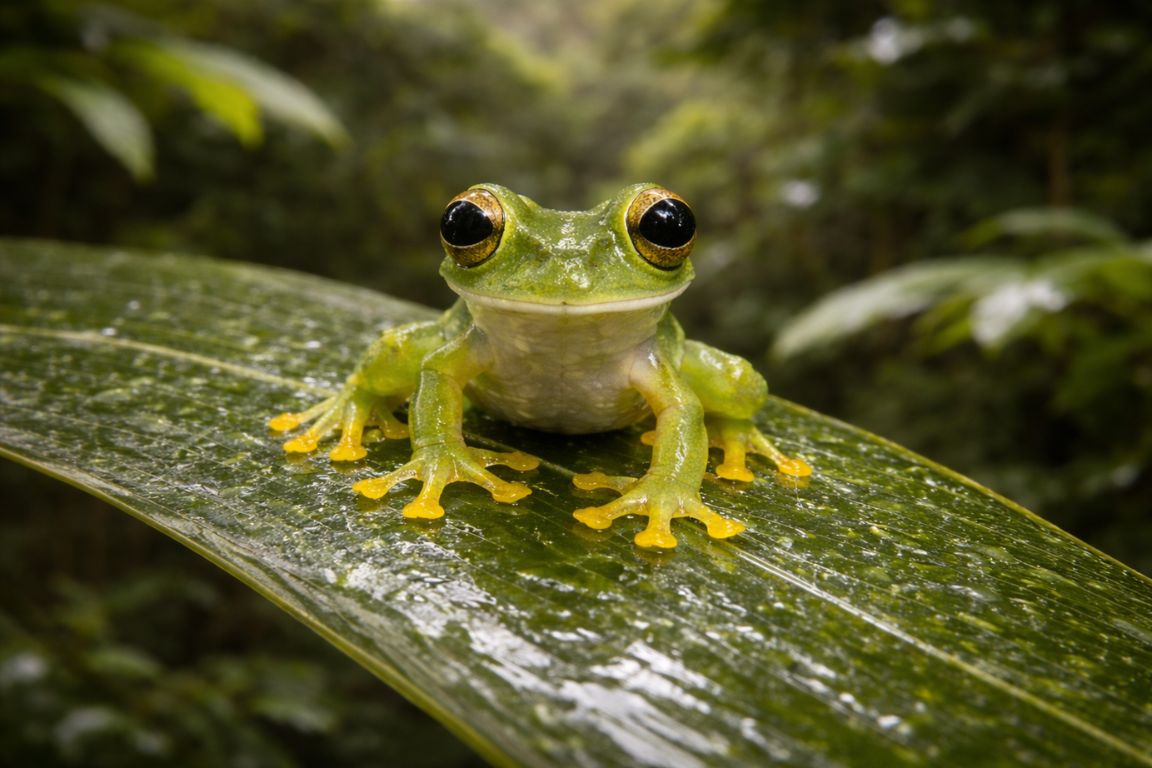
What those walks actually produce is well documented by the operators themselves: kinkajous, armadillos, porcupines, sloths wedged in fruit trees, sleeping birds, eyelash palm pit vipers coiled at eye level, tarantulas and glass frogs. That is a strong two hours of wildlife by any standard. If a cat ever appears, it will be an ocelot or a margay crossing a light beam for two seconds. Choosing a night walk is worth a few minutes of reading, because four overlapping versions are sold here and they differ on group size and equipment more than on route.
What will you actually see on a Monteverde wildlife tour?
Birds, in extraordinary numbers, plus coatis, agoutis, capuchins and the sound of howler monkeys carrying for kilometres at dawn. Monteverde holds over 400 bird species, more than 100 mammal species (58 of them bats), 161 reptiles and amphibians and roughly 2.5% of global biodiversity in one reserve. The cats are the smallest, least visible part of that.
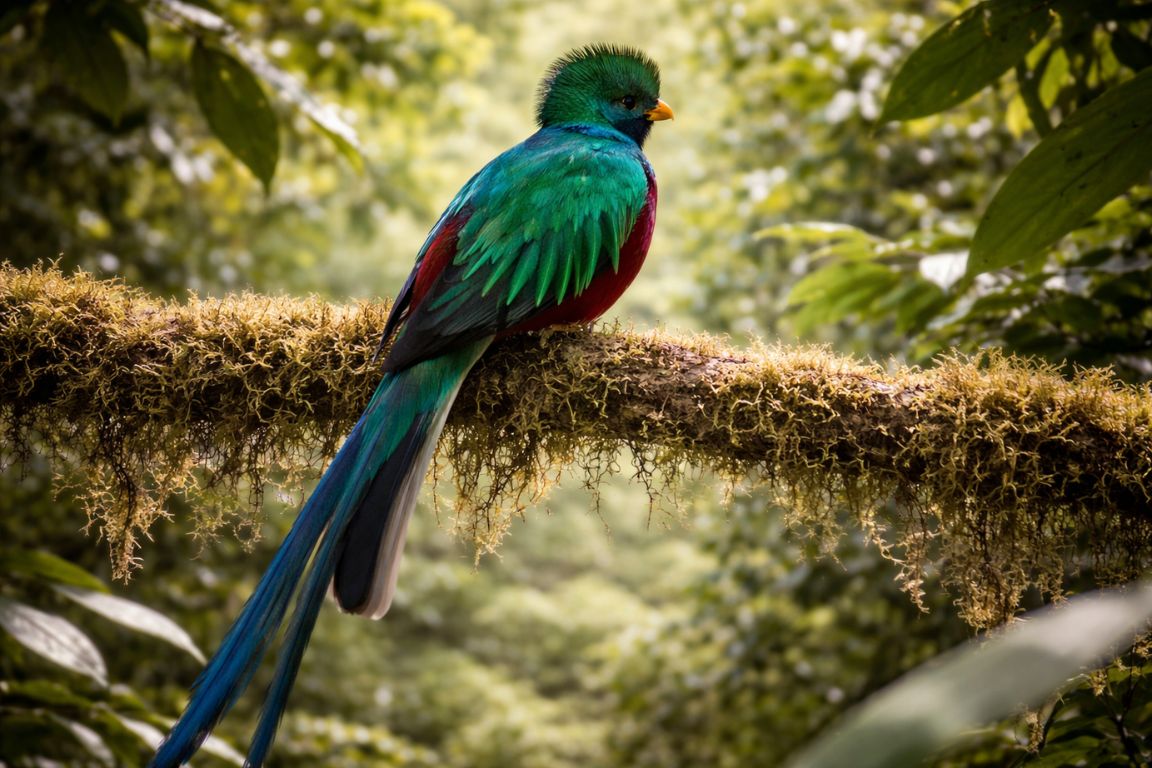
The resplendent quetzal is the sighting that carries this destination, findable from February through June with March and April strongest, and finding the resplendent quetzal is a far better use of planning energy than hoping for a big cat. For the rest, our Monteverde wildlife guide covers what is common, what is seasonal and what is genuinely rare, and what sloth spotting really looks like here applies the same honesty test to the other animal everyone asks about.
Is it still worth going if you will never see a jaguar?
Yes, provided you came for a forest rather than for a species. If you are planning a Monteverde trip around wildlife, build it around birds, amphibians and the after-dark hours, all of which reward the effort in a way big cats never will for a visitor.
There is a quieter satisfaction in the jaguar answer too. The reason nobody sees them is the reason they are still here: a privately managed reserve large enough, connected enough and undisturbed enough to hold an apex predator that will not tolerate people. You walk 13 km of trail through a fraction of it, and somewhere out in the other 97% an animal you will never meet is going about its night. Whether Monteverde earns its place in your itinerary rests on being able to find that thought satisfying rather than frustrating.
Choose Your Monteverde Experience
An editorial starting point, before you enter preferences. Confirm dates, party requirements and extras.
Monteverde Reserve Naturalist Walk
Check your travel date before arranging the rest of this outing. Explore the main reserve with a naturalist and shared spotting scope.
2–3 hours; English/Spanish. Meet at the reserve reception; reserve admission and hotel transport cost extra. Listed ages 3–90, minimum two travellers; confirm the circuit before buying admission.
Choose a date for Viator scheduled departures. Final availability and price are confirmed on Viator.
Choose only what matters. Missing answers keep the recommendation provisional. Individual suitability and exact pickup still need confirmation.
| Monteverde Reserve Naturalist Walk | Explore the main reserve with a naturalist and shared spotting scope. 2–3 hours; English/Spanish. Meet at the reserve reception; reserve admission and hotel transport cost extra. Listed ages 3–90, minimum two travellers; confirm the circuit before buying admission. |
|---|---|
| Wildlife Refuge Small-Group Night Walk | Search for nocturnal wildlife with a guide, flashlights and spotting scope. 2 hours; English/Spanish. Meet at Monteverde Wildlife Refuge. Reserve entry and transport are extra. Confirm child arrangements and the chosen group option. Sightings are not guaranteed. |
| Curi-Cancha Cloud And Transitional Forest Walk | Discover cloud and transitional forest with a guide and spotting scope. 2.5 hours; English/Spanish, maximum eight. This visits Curi-Cancha, not Monteverde Reserve. Admission is extra; arrange your meeting-point transport. Not suitable under six or with mobility impairments. |
Compare Your Group’s Costs
Enter your own quotes in the same currency for the same people. Include admission, transport and fees on both sides. These are your totals, not live tour prices.
Enter both totals to compare the cost of your independent plan with the guided experience.